
 Click for reviews

Morningstar TriStar Charge Controllers
Morningstar TriStar PWM & MPPT Charge Controller Models
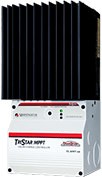

TriStar PWM vs. TriStar MPPT Review
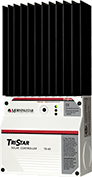
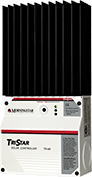
TriStar PWM Solar Charge Controllers
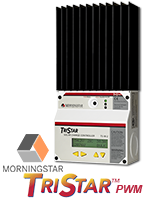
Morningstar's TriStar PWM charge controllers are three-function controllers that provides reliable solar battery charging, load control or diversion regulation. These controllers operate in one of these modes at a time and two or more controllers may be used to provide multiple functions.
Rated at up to 60 amps, TriStar charge controllers will function at a wide voltage range of 12-48 volts. Multiple TriStar PWM charge controllers can be run in parallel for larger solar arrays up to 300 amps or more. Options include an optional meter, remote meter and remote temperature sensor to better meet the needs of off-grid solar systems.
Highest Reliability
Large heat sink and conservative design enables operating at full ratings to 140°F. No
need to de-rate.
More Power
Ratings to 60A at 48VDC will handle solar arrays up to 4kW.
Communications Capability
RS-232 connects to a personal computer for custom settings, data logging and remote
monitoring and control.

The TriStar TS-45 & TS-60 are often chosen because they produce low telecom radio noise. These models are available for our remote solar systems.
Fully Adjustable
DIP switch provides users with a choice of 7 different digital presets and custom settings
via RS-232.
Extensive Electronic Protections
Fully protected against reverse polarity, short circuit, overcurrent, high temperature and
overvoltage.
Simple Mechanical Interface
Larger power terminals and conduit knockouts. Extra space for wire turns. Fits on power
panels.
Better Battery Charging
Connecting battery sense wires and optional remote temperature sensor will improve
control accuracy. Constant voltage series PWM algorithm increases battery capacity and life.
More Information
3 LEDs to indicate status, faults and alarms. Optional meter displays extensive system and
controller information, automatic self-test and reset capabilities. Meter
connection via RJ-11 phone jack.
Easy to Reset
Pushbutton provides manual reset and stop/start battery equalization or load disconnect.
Low Telecom Noise
DIP switch setting will change PWM to “On-Off” battery charging.
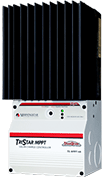
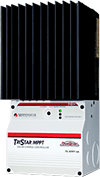
TriStar MPPT Solar Charge Controllers
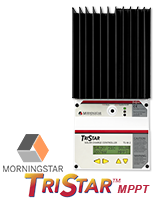
Morningstar TriStar MPPT charge controllers use TrakStar technology for efficient and reliable solar battery charging. They can provide up to 60 amps on an up to 150 volt open circuit input. The TriStar MPPT solar charge controller with TrakStar technology is an advanced maximum power point tracking (MPPT) solar battery charger for off-grid solar systems up to 3kW.
Morningstar TrakStar MPPT Technology
TrakStar is a smart tracking algorithm used by the TriStar MPPT to maximize the energy harvest from the PV by rapidly finding the solar array peak power point with extremely fast sweeping of the entire I-V curve. The Morningstar TriStar MPPT solar charge controller provides the industry’s highest peak efficiency of 99% and significantly less power loss compared to other MPPT controllers.
The TriStar MPPT is the first PV controller to include on-board Ethernet for a fully web-enabled interface and includes up to 200 days of data logging.
TriStar MPPT Benefits
- Better peak power point tracking than other MPPT controllers
- Very fast sweeping of the entire I-V curve
- Recognition of multiple power points during shading or mixed PV arrays
- Excellent performance at sunrise and low solar insolation levels

Extremely High Reliability
- Robust thermal design and no cooling fans
- Parallel circuit design provides less stress and longer life for electronic components
- No mechanical relays
- Extensive electronic protections incl. PV short circuit protection
- Epoxy encapsulated inductors and conformally coated printed circuit boards
Very High Efficiency
- Peak efficiency of 99%
- Proprietary tracking algorithm minimizes power losses
- Low self-consumption
- Continuous operation at full power to 45°C without need to de-rate
- Selected electronic devices with higher ratings to minimize losses from heating
TriStar charge controller system advice and wholesale
pricing.
Contact us toll-free: (877) 297-0014
Morningstar TriStar PWM and MPPT charge controllers available with our complete systems..
Contact us toll-free: (877) 297-0014.
Contractor Discounts Available

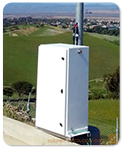
Contact us for remote outdoor solar system sales & advice for PV systems using Morningstar TriStar PWM and MPPT Charge Controllers.