
 Click for reviews
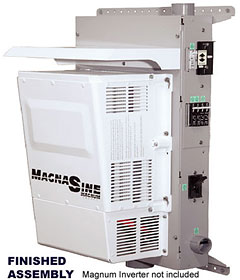
Completely Pre-Assembled Inverter Power Panels



Conservation
Conservation plays an important role in keeping down the cost of a photovoltaic system. The use of energy-efficient appliances and lighting, as well as non-electric alternatives wherever possible, can make solar electricity a cost-competitive alternative to gasoline generators and, in some cases, utility power.
Cooking, Heating and Cooling
Conventional electric cooking, space heating and water heating equipment use a prohibitive amount of electricity. Electric ranges use 1500 watts or more per burner, so bottled propane or natural gas is a popular alternative to electricity for cooking. A microwave oven has about the same power draw, but since food cooks more quickly, the amount of kilowatt hours used may not be large. Propane and wood are generally better alternatives for space heating. Good passive solar design and proper insulation can reduce the need for winter heating. Evaporative cooling is a more reasonable load than air conditioning and in locations with low humidity, the results are almost as good. One big plus for solar cooling: the largest amount of solar energy is available when the need for cooling is the greatest.
Lighting
Lighting requires the most study since many options exist in type, size, voltage and placement. The type of lighting that is best for one system may not be right for another. The first decision is whether your lights will be run on low voltage direct current (DC) or conventional 110 volt alternating current (AC). In a small home, an RV, or a boat, low voltage DC lighting is often the best choice. DC wiring runs can be kept short, allowing the use of fairly small gauge wire. Since an inverter is not required, the system cost is lower. When an inverter is part of the system, and the lights are powered directly by the battery, a home will not be dark if the inverter fails. In addition to conventional-size medium-base low voltage bulbs, the user can choose from a large selection of DC fluorescent lights, which have 3 to 4 times the light output per watt of power used compared with incandescent types. Halogen bulbs are 30% more efficient and actually seem almost twice as bright as similar wattage incandescents given the spectrum of light they produce. High quality fluorescent lights are available for 12 and 24 volt systems. In a large installation or one with many lights, the use of an inverter to supply AC power for conventional lighting is cost effective. AC compact fluorescent lights will save a tremendous amount of energy. It is a good idea to have a DC-powered light in the room where the inverter and batteries are in case there is a problem. AC light dimmers will only function properly on AC power from inverters that have pure sine wave output.
 Refrigeration
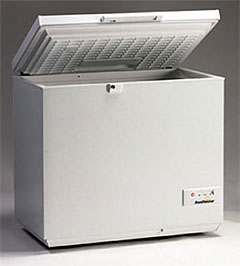
Gas powered absorption
refrigerators are a good choice in small systems if bottled gas is available. Modern
absorption refrigerators consume 5-10 gallons of LP gas/month. If an electric
refrigerator will be used in a standalone system, it should be a high-efficiency type. Some
high-efficiency conventional AC refrigerators use as little as 1200 watt-hours of
electricity/day at a 70º average air temperature. A comparably sized Sun Frost
refrigerator/freezer uses half that amount of energy and a SunDanzer refrigerator (without a
freezer) uses less than 100
watt-hours per day. The higher cost of good quality DC
refrigerators is offset by savings in the number of solar modules and batteries
required.
Major Appliances
Standard AC electric
motors in washing machines, larger shop machinery and tools, swamp coolers, pumps, etc.
(usually 1/4 to 3/4 horsepower) require a large inverter. Often, a 2000 watt
or larger
inverter will be required. These electric motors are sometimes hard to start on inverter
power, they consume relatively large amounts of electricity, and they are very wasteful
compared to high-efficiency motors, which use 50% to 75% less electricity. A standard
washing machine uses between 300 and 500 watt-hours per load, but new front-loading
models
use less than 1/2 as much power. If the appliance is used more than a few hours
per week, it is often cheaper to pay more for a high-efficiency appliance rather than make
your electrical
system larger to support a low-efficiency load. Vacuum cleaners usually
consume 600 to 1,000 watts, depending on how powerful they are, about twice what a washer
uses, but most vacuum
cleaners will operate on inverters larger than 1,000 watts since
they have low-surge motors.
Small Appliances
Many small appliances such as irons, toasters and hair dryers consume a very large amount of power when they are used but by their nature require very short or infrequent use periods. If the system inverter and batteries are large enough, they will be usable. Electronic equipment, such as stereos, televisions, VCRs and computers have a fairly small power draw. Many of these are available in low voltage DC as well as conventional AC versions. In general, DC models use less power than their AC counterparts.
Call toll-free (877) 297-0014 to speak with an experienced representative.