
 Click for reviews
Charge Controllers

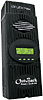
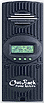
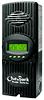
 Morningstar Charge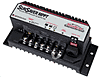
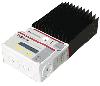
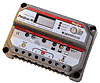
Charge controllers protect batteries from being overcharged.
Charge controllers or voltage regulators protect batteries from being overcharged, which can shorten their life as well as the life expectancy of the equipment being powered. Electronic circuitry in the regulator measures battery voltage, which rises as the battery state-of-charge (SOC) increases. At some voltage (which is different for different types of batteries at different temperatures), the regulator will limit the charging of the battery.
Regulators for photovoltaic (solar electric), wind and water powered systems perform the same function as a voltage regulator in an automobile. However a regulator from a car will not work in a remote power system due to a few differences. Advanced features found in most charge controllers are: low voltage disconnect (LVD), lighting controls, adjustable settings for different battery types, auto equalization, fusing, temperature compensation and reverse polarity protection. Some regulators charge using pulse width modulation (PWM) while others use simple on/off schemes.
We carry charge controllers from name brand manufacturers like Morningstar & Outback. Contact us for more information.
Are charge controllers really necessary?
Most systems have battery capacities more than or equal to 4 days of load requirements and are typical of many PV systems used for residential or outdoor lighting applications. The function of the charge controller(s) in these systems is to protect the batteries from overcharge or overdischarge.
Two systems were tested with malfunctioning or incomplete charge controllers to demonstrate why controllers are needed for the types of PV systems tested here. A system at FSEC initially had a malfunctioning controller that rarely regulated at all and which, on most clear days, continued to try to bulk charge the battery until sunset. This led to maximum battery voltages of 15.0 to 15.3 V on many sunny days, which is excessive for this type of battery. As a result, the battery inthis system had very high water loss. In the post-mortem inspection, the positive grids of this battery were found to be severely corroded.
On the other hand, another system at Sandia initially had no low-voltage disconnect. As a result, the battery in this system was drained to -1.5 V during a cloudy period. At 1.5 V, the controller could not operate properly and disconnected the array from the battery, locking the system into a non- functioning state. Manual intervention was required to restart the system. An external low-voltage disconnect was added to the system after this incident. Note that this problem, which occurred due to the absence of a low voltage disconnect, occurred on the system which otherwise maintained the highest state-of-charge of any of the fourteen systems in this test.