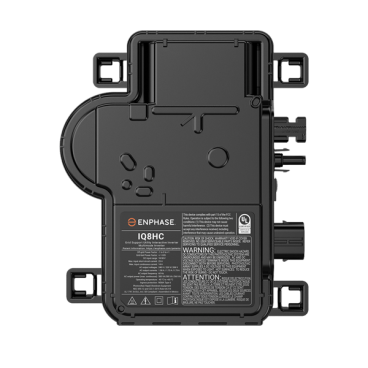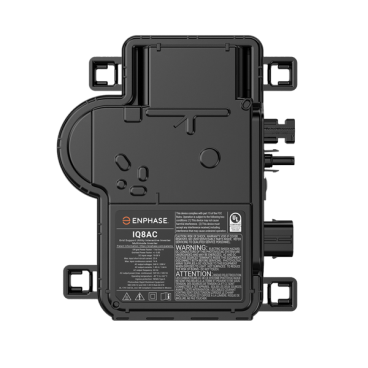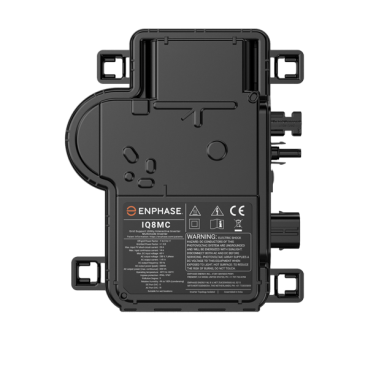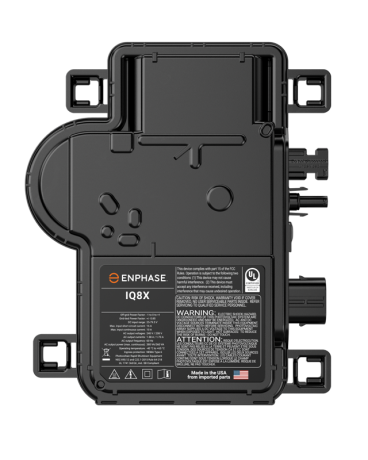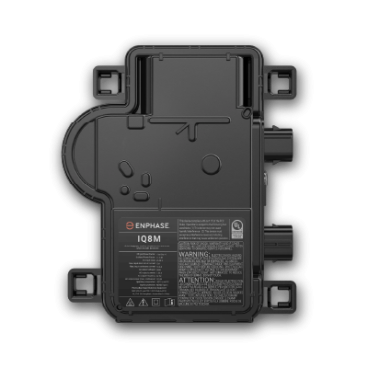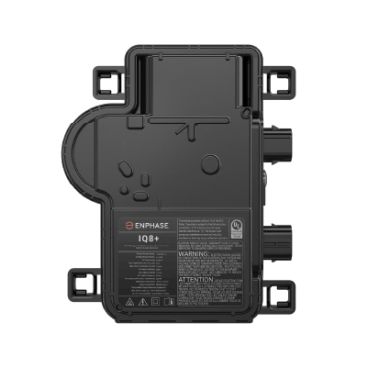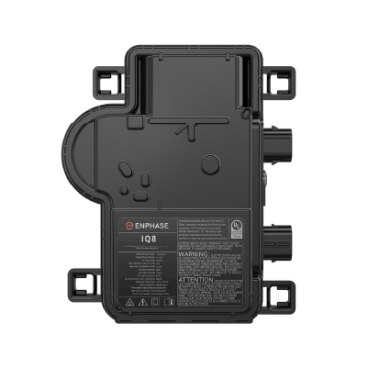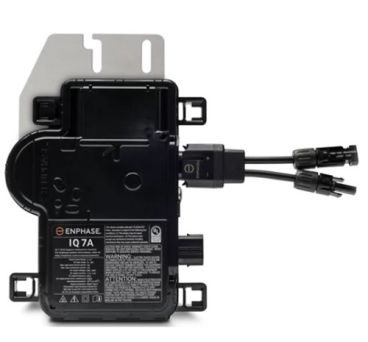
Enphase
Solar Inverter for Grid Tie Systems
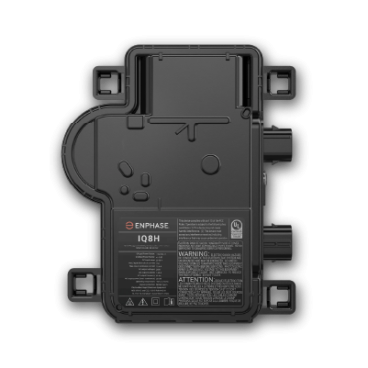
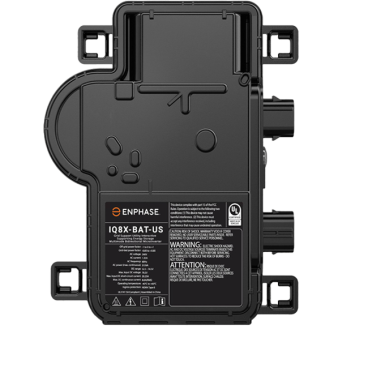
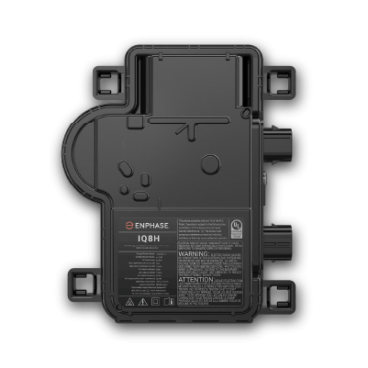
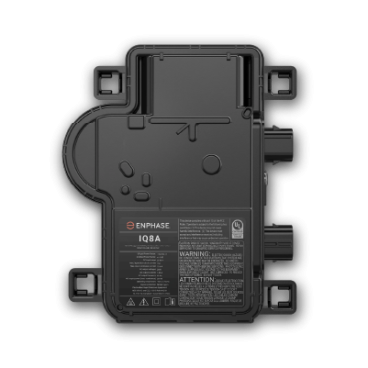
One micro-inverter
per solar module. Envoy allows you to monitor each module through
the Enlighten website.
The Enphase Micro-inverter
system is a fully integrated device that converts the DC output of
a single solar module into grid-compliant AC power. This integrated
system maximizes energy harvest, increases system reliability, and
simplifies design, installation and management. This is the first
commercially available inverter for residential and commercial solar
PV applications that uses one inverter per solar module with MPPT
and a unique way to watch your power production for each solar module.
Welcome to a new generation of solar power grid-tie inverters!
Models include the M175-24-208-S, M175-24-240-S
M200-32-208-S and M200-32-240-S
Micro-Inverters.
|
Productive
Every module gets the benefit of
individual Maximum Power Point Tracking (MPPT),
thereby maximizing energy harvest.
With Enphase Micro-inverters, the modules are
resilient to dust, debris, and shading.
Enphase Burst Mode technology provides greater
production in low-light conditions.
|
Reliable
No single point of failure.
The Micro-inverter provides
continuous monitoring of the
performance of each PV module.
Soft switching reduces component stress.
MTBF of 119 years
|
Smart
Quick and simple installation.
No central or string inverter to
install or design.
The system provides 24/7 monitoring
and management for each module.
|
How Enphase
Energy Differs from a Standard Solar Energy System
Traditional
solar energy installations deploy a single centralized inverter
to convert the DC output from multiple solar modules into AC power.
The Enphase Energy Micro-inverter system is a fully integrated device
that converts the DC output of a single solar module into grid-compliant
AC power. This provides significant benefits over traditional solar
energy systems:
| Traditional
System |
Enphase
System |
Benefits |
| Single
centralized inverter |
One Micro-inverter
per module |
Eliminates concern about where to place a large inverter.
Reduced wiring time.
Eliminates need for DC switching points. |
| Single
MPPT for array |
Individual
MPPT per module |
Maximizes harvest per module.
Increased resilience to obstruction, shading, inter-row
shading,
and obstacles such as dust or debris. |
| Uniform,
co-planar module installation |
Mis-matched,
non-coplanar orientation possible |
Roof area can be maximized.
Configuration flexibility for varying module brands and
ratings.
Modules need not be collocated. |
| String
design |
Branch
circuit design |
No string design required.
No single point of failure.
Degradation of one module does not affect other modules. |
| Third party
per-inverter monitoring |
Integrated
Enlighten per-module monitoring |
Continuous per-module performance monitoring for optimized harvest.
Performance variance detection, analysis, and diagnostics. |
The
Enphase Micro-inverter system is the first commercially-available
Micro-inverter system for residential and commercial solar PV applications.
The Enphase
System includes the following two additional components:
Communications
Gateway
The
module performance information generated by each Micro-inverter
is collected by the Enphase communications gateway called the Energy
Management Unit (EMU). This is also known as the Envoy.
The EMU then transmits this data over a broadband internet connection
to the Enphase Enlighten website.
Enlighten
The
Enphase Enlighten website analyzes the per-module data collected
by each Micro-inverter. Enlighten automatically detects any shortfall
in energy production, identifies possible causes, and suggests solutions
to correct the problem. The Enphase Enlighten website is constantly
monitoring and managing every module on every installation.
Links
to Enphase Inverters:
About
Enphase
Why did Enphase
Energy get started?
Enphase Energy was started to address the challenges associated
with the traditional solar energy model:
Maximizing
the energy harvest of an array of modules.
Having a single inverter for an entire array creates a single
point of failure.
Complex design decisions must be made in sizing DC series
and parallel strings.
Limited monitoring and analysis and no per-panel visibility.
General
Features FAQ
What is a
Micro-inverter?
An inverter is a power converter that converts direct current (DC)
into alternating current (AC). Traditionally, this has meant one,
centrally-located inverter converting all of the DC current from
the entire PV array. A micro-inverter is a much smaller version
of the central inverter where there is one per PV module. The DC
gets converted to AC at the point of the PV module. AC power then
travels upstream through an ordinary branch circuit, and to the
service panel.
What is a
Micro-inverter system?
A Micro-inverter
system is a federation of multiple micro-inverters all along a branch
circuit, and/or within multiple branch circuits, which are all converting
DC to AC, all injecting their current upstream, and reporting back
to Enphase regarding their individual power-production statistics.
What is an
EMU?
The Energy Management Unit is the communications gateway device
which relays power-production statistics from the Micro-inverters
to the Enlighten website.
How do Enphase
Micro-inverters differ from PVAC units?
With PVAC, the inverter and module are a single unit and are sold
and installed as such. In contrast, the Enphase Micro-inverter is
architected as a standalone inverter. This modular design means
the Enphase Micro-inverter offers the flexibility to work with most
off-the-shelf solar modules.
Can Enphase
Micro-inverters work in off-grid environments?
Enphase Micro-inverters have only been tested to work in grid-tied
installations.
Can Enphase
be used in both Residential and Commercial solar deployments?
Yes. Enphase micro-inverters are designed for 240VAC residential,
as well as 208VAC three-phase service.
What solar
modules is the Enphase Micro-inverter compatible with?
The Enphase Micro-inverters (Model M175 240V and Model M175 208V)
work with any 24V nominal module up to 210-215W STC. Enpahse Solar
Inverters (Model M200-32-240-S and Model M200-32-208-S) work with
any 32V nominal solar module. Type 1 and Type 4 (Solarline 2) MC
Connectors are available.
|